


Climatemanagement in Hotels
 Swantje Lehners
The joint Futouris project is part of the implementation phase of the industry project Climate-conscious travel. The aim is to support hotels across Europe in setting up and implementing active climate management for their operations.

Project Objectives
To support hotels in introducing and implementing a systematic climate management system.
To gain insights into emissions along the supply chain (Scope 3) of hotels, as well as into possible approaches for incorporating them into climate management.
Raising awareness among hotel management and employees regarding climate-related issues and operational options for action.
Developing materials for knowledge transfer within the industry.
Tracking, Analyzing, and Managing Emissions in Hotels
Hotels are increasingly facing the challenge of systematically incorporating climate-related requirements and emissions data into their operational management. This requires reliable data, appropriate analytical tools, and a structured climate management system.
The Futouris project “Climate Management in Hotels” addressed precisely this issue. In collaboration with a group of pilot hotels selected by Futouris member companies DERTOUR Group and schauinsland reisen, as well as experts from blueContec and myclimate, the project focused on tracking and analyzing the CO₂e emissions generated by hotel operations. The basis for this was the Hotel Carbon Measurement Initiative (HCMI), an established standard for collecting emissions data in the hotel industry.
Based on the collected data, areas for operational improvement were identified in collaboration with the hotel teams and project partners, and potential measures and objectives for the further development of climate management were developed. Particular emphasis was placed on emissions along the supply chain (Scope 3), which can account for a significant portion of many hotels’ emissions profiles.
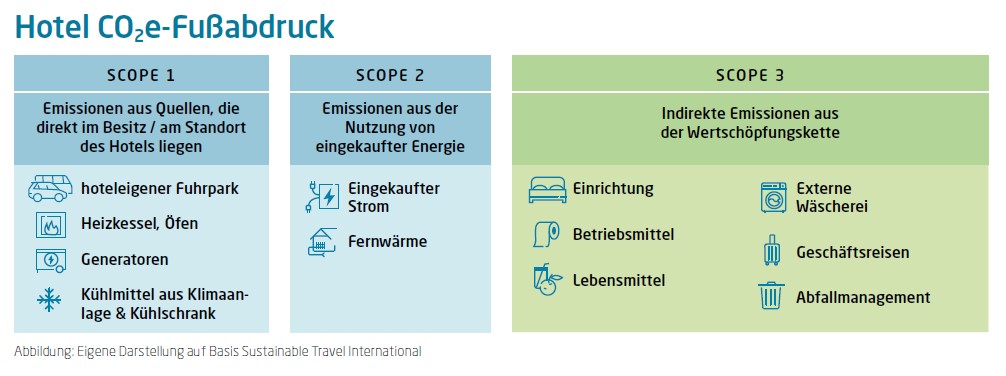
Based on the findings, practical resources and materials—in particular, a comprehensive guide—were developed. These are intended to help make the project’s experiences accessible to other companies in the industry and to promote professional exchange.
The “Climate Management in Hotels” project is part of the implementation phase of the industry-wide “Climate-Conscious Travel” project. By providing expertise, methods, and tools, this subproject supports hotels in introducing and further developing a systematic climate management system.
Project Activities
Kick-off workshops with the pilot hotels on project objectives, calculation methods, system boundaries, and potential approaches to climate management.
Data collection to record and analyze CO₂e emissions in the participating hotels.
On-site climate audits to identify relevant emission sources and areas for operational improvement.
Development of customized roadmaps for the participating hotels, including targets, strategies, and potential measures for further developing climate management.
Testing of selected measures, along with ongoing monitoring and evaluation of the results.
Development of a guide featuring practical examples and actionable recommendations for other industry stakeholders.
Knowledge transfer to the industry through communication of project results, distribution of the guide, and hosting of an online event.
Guide to Climate Management in Hotels and Resorts
As part of the project, a guide to climate management in the hotel industry was developed. The guide is based on the findings from the climate audits conducted at the pilot hotels and describes key sources of emissions as well as potential starting points for further developing a systematic climate management system in hotel operations.
Zum Leitfaden